We may earn a commission when you buy through links on this page. As an Amazon Associate we earn from qualifying purchases. How we make money.
Quick answer
Best overall: Nike Romaleos 4. It has a 20 mm heel, two straps and the widest, most planted base in its class. Best value: Nike Savaleos, about half the price with a 15 mm heel that suits most gym-goers. Wide feet: TYR L-1 Lifter. If you mainly deadlift or low-bar squat, skip lifters and wear a flat shoe instead.
When I started digging into lifting shoes, the heel heights were the most confusing part. No two sites list them the same way, and a couple of millimetres actually matters here. So I pulled the specs for every current lifter into one place.
Quick word on how: I haven’t worn these shoes. I compared manufacturer specs, cross-checked them against independent reviews, and read a lot of long-term owner feedback on sizing and durability. Where sources disagree on a number, you’ll see the range instead of whichever figure looks best. There’s more on how we research if you’re curious.
Our top picks
Best overall
Nike Romaleos 4
The most locked-in shoe here. Built for snatches, cleans and heavy squats.
Best value
Nike Savaleos
A real lifter for around half the price. Ideal first pair.
Best for wide feet
TYR L-1 Lifter
Extra-wide toe box and two straps. Your toes can actually spread.
Weightlifting shoes compared
| Shoe | Heel height | Closure | Best for | Typical price |
|---|---|---|---|---|
| Nike Romaleos 4 | 20 mm (0.79″) | Laces + 2 straps | Olympic lifts, heavy squats | $200–230 |
| Adidas Adipower 3 | 20–22 mm* | Laces + 1 strap | Olympic lifts, flat feet | $200–230 |
| Reebok Legacy Lifter III | 20.5–22 mm* | Laces + strap | Tall lifters, deep squats | $200–230 |
| TYR L-1 Lifter | 21 mm (0.83″) | Laces + 2 straps | Wide feet | $200–220 |
| Inov-8 Fastlift Power G 380 | 22 mm (0.87″) | Laces + strap | Narrow feet, tall lifters | ~$210 |
| NOBULL Lifter | 18.5 mm (0.73″) | Laces + strap | Narrow feet, lower heel | ~$299 |
| Nike Savaleos | 15 mm (0.59″) | Laces + 1 strap | Beginners, budget | $90–125 |
| Adidas Powerlift 5 | 15 mm (0.59″) | Laces + 1 strap | Powerlifting, beginners | $110–130 |
How to choose
1. Heel height
This is the big one. A raised heel lets your knees travel forward without your ankles running out of range, so you can sit deeper and stay more upright.
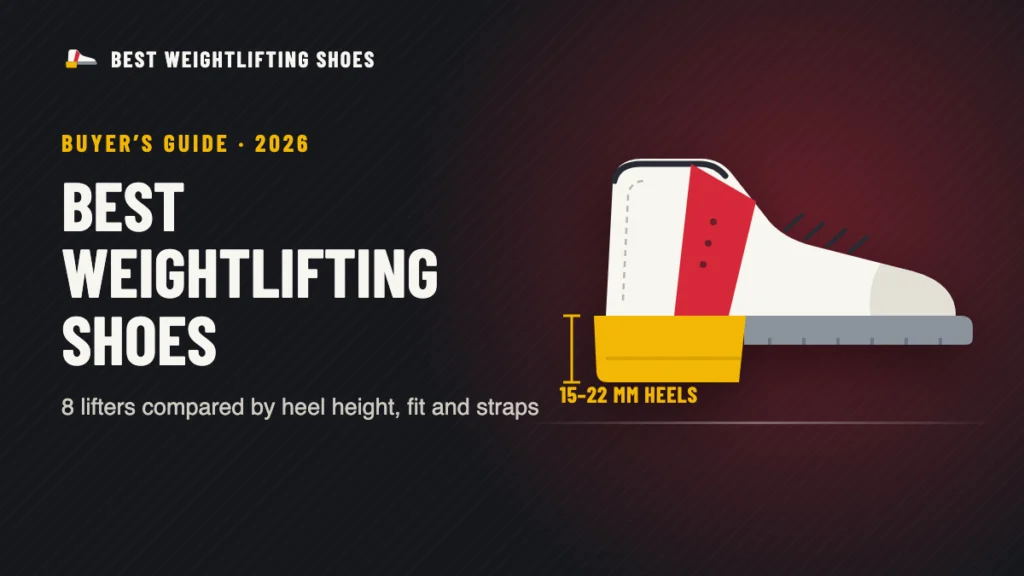
Modern lifters mostly land in two camps. Around 15 mm (0.6″) you get the Savaleos, Powerlift 5 and Lifter PR III. That’s enough to clean up most people’s squat, and it still feels normal for general gym work. Around 20–22 mm (0.75–0.87″) you’re in classic Olympic territory: Romaleos 4, Adipower 3, Legacy Lifter III, TYR L-1 and the Fastlift Power G 380. Taller lifters and anyone with stiff ankles tend to like the higher end.
Not sure? Start at 15 mm. It’s easier to get used to, and you can always go taller later. That’s what I’d do.
2. Foot shape
A lifter that pinches your toes will wreck your balance no matter how good its heel is. If you have wide feet, look at the TYR L-1 or the Savaleos. If yours are narrow, the Inov-8 Fastlift Power G 380 and NOBULL Lifter hug the foot better. More on that in our guide to lifting shoes for women, which covers narrower lasts in detail.
3. Straps and stiffness
Two straps (Romaleos 4, TYR L-1) lock the midfoot down harder, which you’ll notice when you catch a heavy clean. One strap is plenty for squats. Stiffness matters too: the budget shoes use a more responsive midsole that’s comfortable but can feel a little springy under very heavy loads.
The best weightlifting shoes, in detail
Best overall
Nike Romaleos 4
- Heel height20 mm (0.79″)
- Weight~19 oz (US 10.5)
- ClosureLaces + 2 straps
- Best forOlympic lifts, heavy squats
The Romaleos 4 still tops more 2026 review roundups than any other lifter, and the reason is simple: it’s hard to find anything more stable. The outsole is wide and flat, the heel is dense, and the two straps pin your midfoot so it doesn’t shift when you drop under a bar. The trade-off is weight and stiffness. It feels like a tool, not a sneaker, and you won’t want to run a warm-up mile in it.
Pros
- Very wide, planted base
- Two straps for serious lockdown
- Classic 20 mm Olympic heel
Cons
- Heavy and stiff
- Pricey if you only squat once a week
Best value
Nike Savaleos
- Heel height~15 mm (0.59″)
- ClosureLaces + 1 strap
- FitWide toe box, can run small
- Best forBeginners, squats, mixed training
If you’ve never owned lifters, this is the pair we’d point you to. You get a genuine raised heel and a strap for roughly half what the premium shoes cost. The toe box is roomy, which reviewers consistently praise for balance. Two honest caveats: the midsole is a bit springy for very heavy singles, and owners report the upper wears faster than on the Romaleos. Several buyers also say it runs small, so consider going up half a size.
Pros
- Great price for a real lifter
- Roomy toe box
- Easy heel height to adapt to
Cons
- Softer feel under max loads
- Upper less durable
Best for wide feet
TYR L-1 Lifter
- Heel height21 mm (0.83″)
- ClosureLaces + 2 straps
- FitExtra-wide toe box
- Best forWide feet, Olympic lifts
Most lifters are built on narrow lasts, which is a problem if your forefoot is wide. The L-1 fixes that with an extra-wide toe box and a broad, flat sole, then adds two adjustable straps so the roomier fit doesn’t turn sloppy. With a 21 mm heel, it sits right in Olympic-lifting territory. Narrow feet? It’ll probably feel loose, so look at the Fastlift or NOBULL instead.
Pros
- Room for wide forefeet
- Dual straps
Cons
- Too roomy for narrow feet
Best for tall lifters
Reebok Legacy Lifter III
- Heel height20.5–22 mm
- ClosureLaces + strap
- FitRoomy
- Best forLong legs, deep high-bar squats
One of the tallest heels you can buy off the shelf. If you’ve got long femurs and your squat folds forward no matter what you do, that extra height can make a big difference. Reviewers measure it slightly differently (20.5 to 22 mm), but either way it’s on the high side. Low-bar squatters will find it pushes them too far forward.
Best for narrow feet
Inov-8 Fastlift Power G 380
- Heel height22 mm (0.87″)
- Weight380 g
- FitNarrow to neutral
- Best forNarrow feet, women, tall lifters
The Fastlift Power G 380 pairs a tall 22 mm heel with a snug, narrow fit. That combination is surprisingly rare, and it’s why the shoe shows up so often in recommendations for women and anyone with slim feet. It’s lighter than the Romaleos too. Wide-footed lifters should look elsewhere.
Best for powerlifting
Adidas Powerlift 5
- Heel height15 mm (0.59″)
- ClosureLaces + 1 strap
- Best forSquats, bench, beginners
The Powerlift has been the default “first lifting shoe” for years, and the fifth version keeps the formula: a modest 15 mm heel, a single strap, and a price that won’t sting. It’s a good match for powerlifters who squat high-bar or want a stable shoe for bench. Just don’t expect it to feel like a true Olympic lifter.
Also worth a look
- The Adidas Adipower 3 is a premium single-strap lifter that reviewers often recommend for flat feet thanks to its supportive upper. Sources list the heel anywhere from 20 to 22 mm.
- The NOBULL Lifter has a lower 18.5 mm stacked-leather heel that feels closer to a sneaker. Reviews are mixed, and at about $299 it’s the priciest shoe here. Owners often size up half a size.
- The Do-Win Classic Lifter is a budget stacked-leather-heel option. Good value up front, but there are questions about long-term durability.
Who doesn’t need weightlifting shoes?
Lifters aren’t for every lift. For deadlifts, you want to be as close to the floor as possible, so a flat shoe (or socks, if your gym allows it) is better. Low-bar squatters with a wide stance often prefer flat shoes too. And if your training is mostly machines and dumbbells, a good cross-trainer will do the job. Our squat shoe guide breaks down which squat style suits which shoe.
Our verdict
Serious about Olympic lifting? Romaleos 4. Everyone else? Start with the Savaleos.
If you snatch and clean regularly, the Romaleos 4’s stability is worth the money. If you mostly want a better squat, the Savaleos gives you most of the benefit for about half the price. Wide feet? Go straight to the TYR L-1.
FAQ
Are weightlifting shoes worth it for beginners?
Yes, if you squat or do Olympic lifts at least once a week. A raised heel makes it easier to hit depth with an upright torso, and a budget pair like the Nike Savaleos or Adidas Powerlift 5 costs about the same as a regular trainer.
What heel height should I get?
Around 15 mm (0.6″) for general training and most beginners. Around 20–22 mm (0.75–0.87″) for Olympic lifting, deep high-bar or front squats, tall lifters and stiff ankles.
Can I deadlift in weightlifting shoes?
You can, but it’s not ideal. The raised heel lengthens the distance the bar travels and shifts your weight forward. Most lifters change into flat shoes for deadlifts.
How should weightlifting shoes fit?
Snug, with no heel lift and no side-to-side movement, but your toes shouldn’t be jammed against the front. Snugger than a running shoe is normal. Painful is not.
How long do weightlifting shoes last?
Because you mostly stand still in them, a good pair often lasts years. Budget shoes with softer midsoles and lighter uppers tend to wear out sooner than premium ones with dense heels.