We may earn a commission when you buy through links on this page. As an Amazon Associate we earn from qualifying purchases. How we make money.
Quick answer
High-bar or front squats: a 20 mm lifter like the Nike Romaleos 4. Not sure yet / beginner: a 15 mm heel like the Nike Savaleos or Adidas Powerlift 5. Low-bar, wide stance: a flat shoe usually works better than a lifter.
Most “best squat shoe” lists skip the obvious question: which squat? A narrow, upright high-bar squat and a wide, sit-back low-bar squat want different things from your feet. I went through a pile of reviews for this guide before it clicked that half of them were arguing about different squats. Figure out your style first and the shoe pretty much picks itself.
Which heel height for which squat?
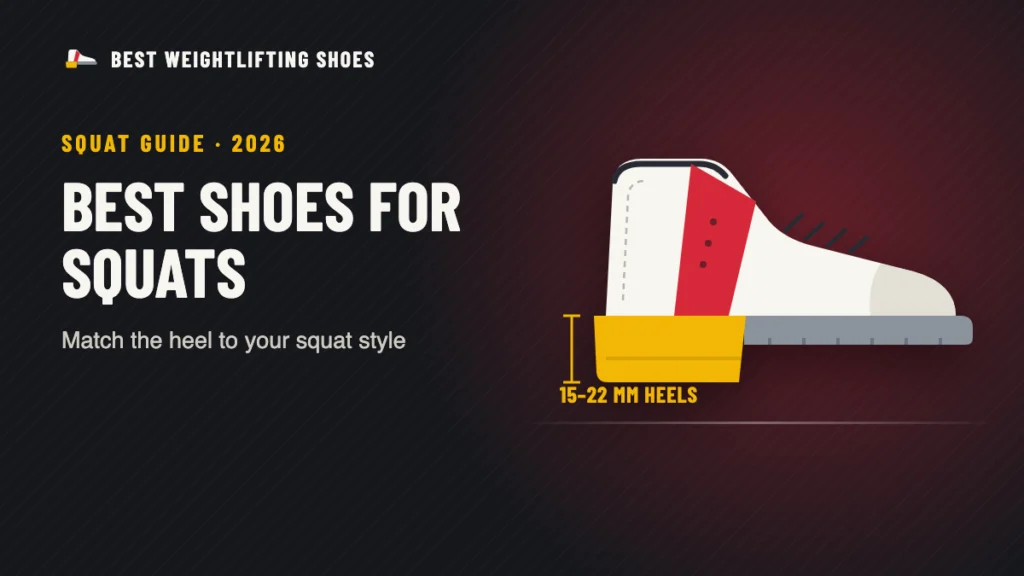
High-bar and front squats keep your chest up and push your knees a long way forward. That’s where a 20–22 mm heel earns its keep. It gives your ankles some slack, so you can sit deep without your heels popping up.
If you squat as part of general training, about 15 mm is plenty. It cleans up depth for most people and doesn’t feel like standing on a ramp.
Low-bar is the odd one out. You sit back into your hips, and a raised heel tips you forward. That fights the whole movement, so flat shoes usually win here.
Stiff ankles or long thighs? Lean toward the taller end. If your heels pop up at the bottom of a bodyweight squat, a lifter will probably help a lot.
Our squat shoe picks
High-bar & front
Nike Romaleos 4
20 mm heel and two straps. Rock solid when the bar gets heavy.
Best for most
Nike Savaleos
15 mm heel, roomy toe box and a friendly price. Great first pair.
Long legs
Reebok Legacy Lifter III
One of the tallest heels around. Helps lifters who fold forward.
| Shoe | Heel height | Closure | Best for | Typical price |
|---|---|---|---|---|
| Nike Romaleos 4 | 20 mm (0.79") | Laces + 2 straps | Olympic lifts, heavy squats | $200–230 |
| Reebok Legacy Lifter III | 20.5–22 mm* | Laces + strap | Olympic lifts, tall lifters | $200–230 |
| TYR L-1 Lifter | 21 mm (0.83") | Laces + 2 straps | Wide feet, Olympic lifts | $200–220 |
| Nike Savaleos | 15–15.5 mm* | Laces + 1 strap | Beginners, budget | $90–125 |
| Adidas Powerlift 5 | 15 mm (0.59") | Laces + 1 strap | Beginners, powerlifting | $110–130 |
Best for high-bar & front squats
Nike Romaleos 4
- Heel height20 mm (0.79")
- Weight~19 oz (US 10.5)
- ClosureLaces + 2 straps
- FitWide, flat base; true to size for most
- Best forOlympic lifts, heavy squats
If you squat high-bar or front squat a lot, the Romaleos 4 is about as stable as a shoe gets. The base is wide and flat, the heel doesn’t squish, and two straps keep your midfoot from sliding when you drive out of the hole. It’s heavy and stiff, so it’s a squat-and-lift shoe, not an all-day trainer.
Pros
- Very stable under heavy loads
- Two-strap lockdown
Cons
- Heavy
- Premium price
Best for most people
Nike Savaleos
- Heel height15–15.5 mm
- ClosureLaces + 1 strap
- FitWide toe box; some say it runs small
- Best forBeginners, budget
For lifters who squat a couple of times a week and want better depth, the Savaleos hits a sweet spot. The 15 mm heel is easy to adapt to and the wide toe box helps you grip the floor. Owners note it can feel a little springy under max attempts and that the upper isn’t as tough as premium shoes. Some also say it runs small, so check sizing.
Pros
- Affordable
- Wide toe box
- Easy to adapt to
Cons
- Softer under max loads
Best for tall lifters
Reebok Legacy Lifter III
- Heel height20.5–22 mm
- ClosureLaces + strap
- FitRoomy
- Best forOlympic lifts, tall lifters
Long femurs make upright squatting hard, because your knees need to travel a long way forward. The Legacy Lifter III’s tall heel (measured at 20.5–22 mm) gives you that extra range. Skip it if you squat low-bar; it’ll tip you forward.
Pros
- Tall heel for long legs
- Roomy fit
Cons
- Too much heel for low-bar
Best for powerlifters
Adidas Powerlift 5
- Heel height15 mm (0.59")
- ClosureLaces + 1 strap
- FitNarrow-ish
- Best forBeginners, powerlifting
Powerlifters who squat high-bar but don’t need a full Olympic shoe often land on the Powerlift. The 15 mm heel and single strap keep things simple, and it doubles as a stable bench shoe.
Pros
- Good for squat and bench
- Budget friendly
Cons
- Narrow-ish fit
What about low-bar squats?
Go flat. Many low-bar lifters squat in a thin-soled, flat shoe so they can sit back and push through the whole foot. A minimalist trainer works, and so do classic flat canvas sneakers, as long as the sole doesn’t compress. Our main buyer’s guide covers who doesn’t need lifters at all.
Our verdict
Upright squatter? Get a lifter. Low-bar? Stay flat.
For most people starting out, the Nike Savaleos is the easiest win: real heel, fair price. If you front squat or train Olympic lifts, step up to the Romaleos 4.
FAQ
Do squat shoes really make a difference?
For most high-bar and front squatters, yes. A raised heel makes it easier to reach depth with an upright torso, especially if your ankles are stiff. Low-bar squatters usually see less benefit.
Can I squat in running shoes?
It’s not ideal. Soft, cushioned midsoles compress under load, so your feet can wobble. A flat, firm shoe or a lifter is more stable.
Is a higher heel always better for squats?
No. Too much heel shifts your weight forward. Pick the height that matches your squat style and anatomy, and start lower if you’re unsure.